
LED technologies for indoor displays: SMD, COB, COG, IMD and MIP
LED Technologies for HD and UHD Indoor DV LED Displays
Understanding SMD, COB, COG, IMD and MIP Technologies
Indoor Direct View LED displays have evolved rapidly in recent years, driven by the demand for higher resolution, superior image quality, improved durability and more efficient system integration.
Today, professional indoor LED displays are available in several different technologies, including SMD, COB, COG, IMD and MIP. Each technology has specific advantages, limitations and ideal applications depending on pixel pitch, viewing distance, installation environment, budget and performance requirements.
Understanding the differences between these LED technologies is essential when choosing an HD or UHD indoor video wall for corporate spaces, control rooms, broadcast studios, retail environments, museums, auditoriums and high-end digital signage projects.
This guide explains the main indoor LED display technologies, helping you compare their characteristics and identify the most suitable solution for your project.
Why LED Technology Matters
Choosing the right LED technology is one of the most important decisions when designing a professional indoor Direct View LED display. While different technologies may appear similar at first glance, they can deliver significantly different results in terms of image quality, durability, energy efficiency, maintenance requirements and overall cost of ownership.
There is no single technology that is best for every application. The ideal solution depends on factors such as pixel pitch, viewing distance, installation environment, operating conditions and budget. A technology that is perfect for a control room may not be the best choice for a retail store, a corporate boardroom or a broadcast studio.
Modern indoor LED displays are available in a range of advanced technologies designed to meet different performance requirements. Understanding their strengths and limitations helps you select the most appropriate solution for your project while maximizing long-term reliability and return on investment.
The main difference between modern LED technologies lies in how the LED chips are packaged, protected and mounted onto the display module. Different packaging methods directly influence image quality, durability, energy efficiency, maintenance and manufacturing costs.
In the following sections, we compare the five main technologies used in today's professional indoor HD and UHD Direct View LED displays: SMD, COB, COG, IMD and MIP.
1.SMD (Surface-Mounted Device)
SMD (Surface-Mounted Device) is the most established and widely adopted technology for professional indoor LED displays. Each LED package integrates the red, green and blue diodes into a single compact component mounted directly onto the PCB, providing excellent image quality, flexibility and cost-effectiveness across a wide range of applications.
Thanks to its versatility, SMD technology is commonly used for indoor LED displays with pixel pitches above 2.0 mm, making it an excellent choice for retail environments, corporate spaces, auditoriums, museums, digital signage and creative LED installations (because of its flexibility, SMD is the preferred technology for many creative LED displays, curved installations and custom-shaped video walls).
Key advantages include:
- Excellent balance between image quality and cost.
- Wide availability across multiple pixel pitches.
- Ideal for large-format indoor LED displays.
- Supports creative, curved and custom-shaped installations.
- Mature, reliable and well-proven technology.
Things to consider: While SMD remains an outstanding solution for many indoor applications, it is generally less suitable than newer technologies for ultra-fine pixel pitches below 2.0 mm, where higher contrast, increased durability and improved energy efficiency become more important.

2. COB (Chip on Board)
COB (Chip on Board) has become one of the most advanced technologies for fine-pitch indoor Direct View LED displays. Instead of packaging each LED separately, multiple LED chips are mounted directly onto the substrate and protected by a robust encapsulation layer, resulting in improved durability, higher contrast and greater energy efficiency.
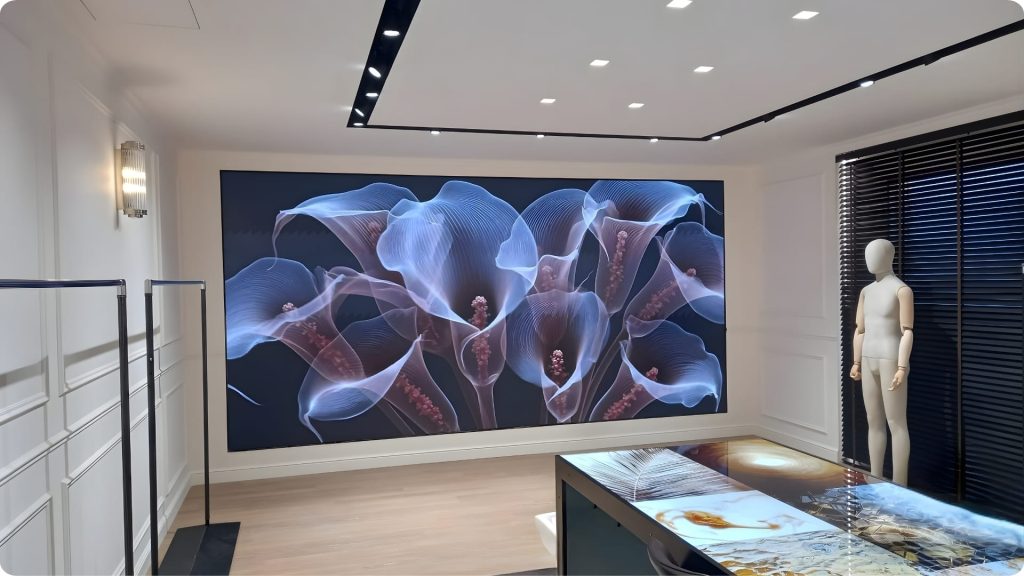
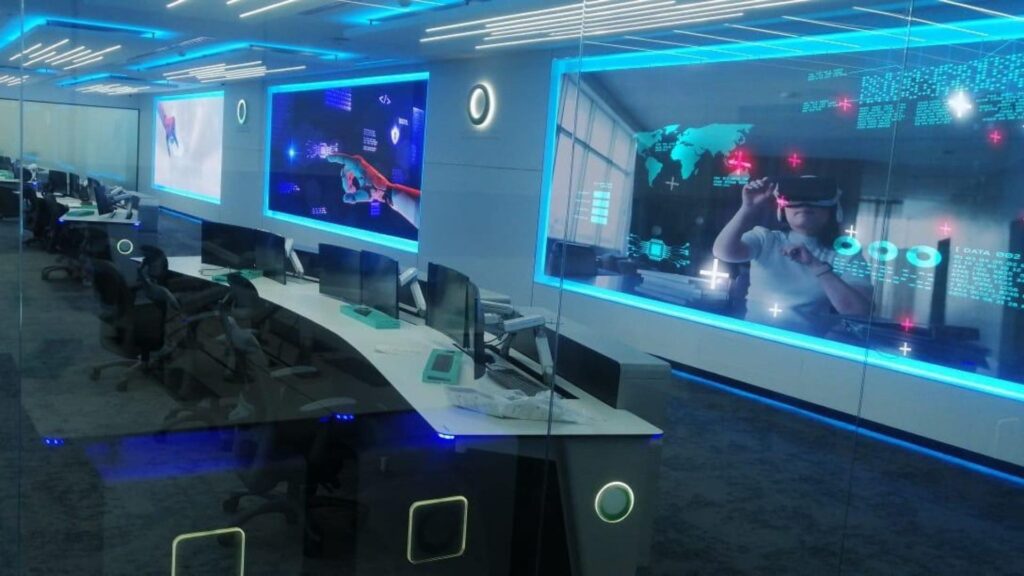
COB technology is particularly suitable for pixel pitches between 0.6 mm and 1.9 mm, making it the preferred choice for control rooms, corporate boardrooms, broadcast studios, luxury retail environments and other premium indoor applications where image quality and reliability are essential.
Key advantages include:
- Exceptional contrast and black uniformity.
- Superior mechanical protection against impacts, dust and humidity.
- Lower power consumption and improved heat dissipation.
- Excellent reliability with minimal maintenance requirements.
- Ideal for premium fine-pitch indoor LED video walls.
Things to consider: COB is optimized for flat, high-performance installations and is generally less suitable for highly creative or curved display designs, where SMD technology still offers greater flexibility.
Today, COB is widely considered the reference technology for premium fine-pitch indoor LED displays.
Want to learn more about COB technology?

3. COG (Chip on Glass)
COG (Chip on Glass) is an emerging LED technology developed for ultra-fine pixel pitch applications where extremely high resolution, ultra-thin construction and premium image quality are required. Unlike conventional LED modules, the LED chips are mounted directly onto a glass substrate, enabling highly compact and lightweight display designs.
Although COG technology is still relatively limited in commercial applications, it represents one of the most promising developments for next-generation indoor HD and UHD Direct View LED displays, particularly where space constraints and exceptional image quality are key requirements.
Key advantages include:
- Ultra-thin and lightweight display construction.
- Excellent colour uniformity and image quality.
- Suitable for extremely fine pixel pitches.
- Potential for innovative display designs and transparent applications.
- Designed for future ultra-high-resolution LED displays.
Things to consider: COG technology is currently less widespread than SMD or COB due to its higher manufacturing complexity and cost. It is mainly adopted in premium applications where ultra-fine resolution and minimal thickness are the highest priorities.
4. IMD (Integrated Matrix Device)
IMD (Integrated Matrix Device) is a hybrid LED technology that combines some of the advantages of traditional SMD with those of newer Mini LED architectures. It has been developed to improve durability, brightness and thermal performance while maintaining a competitive cost.
IMD technology is typically used for indoor LED displays with pixel pitches between 0.9 mm and 2.0 mm, making it suitable for retail environments, corporate applications, XR/VR studios and other installations where higher brightness and improved robustness are desirable.
Key advantages include:
- Improved mechanical durability compared to conventional SMD.
- Higher brightness and better heat dissipation.
- Good balance between performance and investment.
- Suitable for a wide range of professional indoor applications.
- Excellent compromise between image quality, reliability and cost.
Things to consider: While IMD delivers significant improvements over conventional SMD, it generally does not achieve the same level of contrast, black uniformity and surface protection offered by modern COB technology in premium fine-pitch installations.

5. MIP (Micro LED in Package)
MIP (Micro LED in Package) is one of the latest advancements in indoor LED display technology. It combines the benefits of Micro LED architecture with innovative packaging techniques to deliver exceptional image quality, ultra-fine pixel pitches and outstanding energy efficiency.
Designed for premium HD and UHD Direct View LED displays, MIP technology is particularly suited to luxury retail environments, corporate flagship installations, broadcast studios and high-end 4K or 8K video walls where maximum visual performance is required.
Key advantages include:
- Exceptional image clarity and colour accuracy.
- Excellent energy efficiency and reduced heat generation.
- Outstanding contrast and black uniformity.
- Supports ultra-fine pixel pitches for premium visual applications.
- Designed for next-generation high-resolution LED video walls.
Things to consider: MIP is currently one of the most advanced indoor LED technologies available, but its higher manufacturing complexity and investment make it best suited to premium applications where the highest level of visual performance is required.
Although still at an early stage of market adoption, MIP is expected to play an increasingly important role in next-generation premium indoor LED displays.

How to Choose the Right Indoor LED Technology
There is no single LED technology that is best for every indoor application. The ideal choice depends on several factors, including pixel pitch, viewing distance, installation environment, image quality requirements, budget and long-term operating costs.
While all modern indoor LED technologies deliver outstanding visual performance, each has been developed to meet different technical and commercial requirements.
- Choose SMD if you need a versatile, cost-effective solution for retail, corporate environments, museums, auditoriums or creative LED installations with pixel pitches above 2.0 mm.
- Choose COB if your priority is exceptional contrast, durability, energy efficiency and premium image quality for fine-pitch indoor video walls, control rooms and corporate applications.
- Choose COG for emerging ultra-fine pitch applications where ultra-thin construction and cutting-edge display technology are the primary objectives.
- Choose IMD when you are looking for an excellent balance between brightness, durability and investment in professional indoor installations.
- Choose MIP for premium 4K and 8K video walls requiring the highest levels of resolution, efficiency and visual performance.
If you are unsure which technology best fits your project, our specialists can help you compare the available solutions and recommend the most appropriate indoor LED display based on your application, technical requirements and budget.
The Future of Indoor LED Technologies
Indoor Direct View LED technology continues to evolve rapidly, driven by the demand for higher resolutions, improved energy efficiency, enhanced durability and smarter display management.
Innovations such as ultra-fine pixel pitches, COB encapsulation, Micro LED packaging, HDR image processing, common cathode power architectures and intelligent calibration systems are redefining the performance of modern HD and UHD LED displays.
At the same time, manufacturers are developing thinner cabinets, lighter structures, simplified maintenance systems and advanced remote monitoring capabilities, making professional LED displays more reliable, sustainable and cost-effective than ever before.
As these technologies continue to mature, indoor LED displays are increasingly replacing traditional LCD and projection systems across corporate environments, control rooms, broadcast studios, museums, retail spaces and other mission-critical applications.
Want to learn more about the latest innovations in indoor LED displays?
Discover how indoor Direct View LED technology is evolving →
Looking for Outdoor LED Display Technologies?
Indoor and outdoor LED displays are designed to operate in completely different environments and therefore rely on different technologies. While this guide focuses on HD and UHD indoor Direct View LED displays, outdoor installations require solutions optimized for high brightness, weather resistance, long viewing distances and harsh environmental conditions.
Modern outdoor LED displays primarily use SMD and DIP technologies, each offering specific advantages depending on the application, pixel pitch and operating environment.
Read our complete guide to SMD and DIP technologies for outdoor LED displays →
Need Help Choosing the Right Indoor LED Technology?
Selecting the best LED technology is essential to achieving the right balance between image quality, durability, energy efficiency and long-term value. Whether you are designing a corporate video wall, a control room, a broadcast studio or a premium retail installation, our specialists can help you identify the most suitable solution.
Contact MacroPix today to receive expert advice and discover the ideal indoor LED technology for your next project.