
SMD or DIP LED for outdoor LED display technology
Choosing between SMD and DIP LED technology is one of the most important decisions when selecting an outdoor LED display, as it directly impacts brightness, image quality, durability and cost.
Outdoor LED technology has existed for more than 30 years — yet creating a screen that truly lasts, performs, and stays flawless in real outdoor conditions is still a challenge. That’s why choosing a certified, experienced partner is essential to ensure durability, safety, and long-term visual excellence. Below you can find some basic information.
Overview of Outdoor LED Technologies
For many years, outdoor LED screens were built exclusively using DIP (Dual In-Line Package) LEDs. These cylindrical RGB diodes are mounted through the PCB and are known for extreme brightness, durability, and energy efficiency, typically used for pixel pitches of 16 mm or larger.
As LED technology evolved, SMD (Surface-Mount Device) LEDs—originally used indoors—became suitable for outdoor environments thanks to waterproof treatments, UV-protection, and improved encapsulation. Today they dominate most high-resolution outdoor installations.
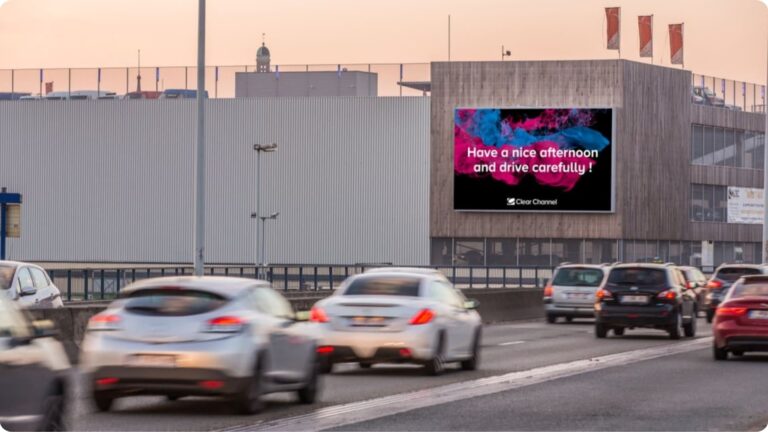
1. DIP LED Technology for Outdoor Displays
Characteristics
Very high brightness (up to 12,000–15,000 NIT)
Excellent energy efficiency
Long lifespan, particularly in high-temperature environments
High robustness against UV and harsh weather
Pixel pitches typically from 16 mm to 50 mm
Advantages (PROS)
Best choice for very large billboards and long-distance visibility
Superior performance under strong direct sunlight
Lower power consumption at high brightness levels
Exceptional durability and stability over time
Limitations (CONS)
Lower color uniformity compared to SMD
Narrower viewing angles
Lower definition for close-range viewing
Larger pixel pitch, unsuitable for small or medium-sized screens
DIP is still effective when the minimum viewing distance is above 25–30 meters and when brightness is the primary requirement.
2. SMD LED Technology for Outdoor Displays
Characteristics
Modern outdoor SMD LEDs use miniaturised RGB chips enclosed in a single package and welded directly onto the PCB. Thanks to resin treatments like GOB, AOB, or HOB, SMD modules now reach high levels of waterproofing, UV protection, and mechanical resistance in any environment.
Outdoor SMD screens today cover pixel pitches from 1.2 mm to 10 mm with the best selling models being today 2.9 mm, 3.9 mm, 4.4, 5.7 and 6.6 mm pixel pitches, offering much higher resolution than DIP.
Advantages (PROS)
Better image quality at short and medium distances
Wider viewing angle (>120° horizontally and vertically)
More compact pixel structure → smoother images
Ideal for stadiums, media façades, OOH advertising, retail windows, smart cities
Available in narrow pixel pitches (even down to 1.2 mm, 1.5 and 1.9 mm)
Excellent colour uniformity and on-camera performance
Limitations (CONS)
Slightly lower maximum brightness than DIP (typically 6,000–10,000 NIT)
Requires high-quality encapsulation and materials to ensure long-term outdoor reliability
Slightly higher power consumption at equivalent brightness levels
With modern treatments and high-grade components, top-tier outdoor SMD displays now offer durability and reliability equal or superior to DIP.
SMD vs DIP: key differences
- Brightness: DIP higher (up to 15,000 NIT)
- Image quality: SMD better at close range
- Viewing angle: SMD wider
- Durability: DIP stronger in extreme conditions
- Resolution: SMD supports finer pixel pitch
Want to understand how outdoor LED specifications affect cost?
See LED display price guide →
https://www.macropix.com/led-display-price-guide
Which Technology Should You Choose?
Choose SMD if you need:
Medium or close-range viewing
High image quality
Wide viewing angles
Pixel pitch equal or below 10 mm
Architectural or commercial installations
Choose DIP if you need:
Maximum brightness
Very large screens viewed from long distances
Extreme outdoor durability in very hot climates
The lowest operating cost at high NIT levels
Not sure which LED display is right for your project?
Learn how to choose the right LED display →
https://www.macropix.com/projects-macropix/
Market Trend: SMD Dominance for Outdoor Displays
Today, over 90% of new outdoor LED displays use SMD technology, particularly in:
Stadiums
Transportation hubs
DOOH networks
Retail windows
Smart city projects
LED billboards with medium viewing distance
DIP is still relevant for specific large-format, long-distance installations, but the overall trend is toward high-definition SMD outdoor technology thanks to its versatility and superior visual performance.
See how outdoor LED displays are used in real projects.
Explore LED display installations →
https://www.macropix.com/projects/
Need help choosing between SMD and DIP?
Contact MacroPix to identify the best outdoor LED solution based on your installation, environment and performance requirements.